| The plazas de soberanía
("places of sovereignty"), formerly referred as "África Septentrional
Española" (Spanish North Africa) or simply "África
Española" (Spanish Africa) are the current Spanish territories in
continental North Africa, bordering Morocco.
Since the Reconquista, the
Spanish army conquered and maintained numerous emplacements in North Africa
as a defense against North Africa. Many of them, such as Oran, have been
lost, and nowadays, with an approximate population of 143,000 people, only
the autonomous cities of Ceuta and Melilla, which constitute
the two plazas mayores de soberanía (or large places of sovereignty),
and the Islas Chafarinas, the Peñón de Alhucemas and the
Peñón de Vélez de la Gomera, which constitute the
three plazas menores de soberanía (or lesser sovereignty places),
are still part of Spain. |
 |
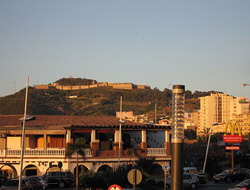 Ceuta
is located on the North African side of the Strait of Gibraltar, on the
Mediterranean, which separates it from the Spanish mainland. The area of
Ceuta is approximately 28 square kilometres (11 sq mi). Ceuta is
dominated by a hill called Monte Hacho, on which there is a fort used by
the Spanish Army. Monte Hacho is one of the possible locations for the
southern of the Pillars of Hercules of Greek legend, the other possibility
being Jebel Musa. Ceuta
is located on the North African side of the Strait of Gibraltar, on the
Mediterranean, which separates it from the Spanish mainland. The area of
Ceuta is approximately 28 square kilometres (11 sq mi). Ceuta is
dominated by a hill called Monte Hacho, on which there is a fort used by
the Spanish Army. Monte Hacho is one of the possible locations for the
southern of the Pillars of Hercules of Greek legend, the other possibility
being Jebel Musa.
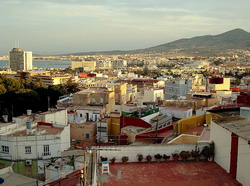 Melilla
(Berber: Tamelilt, meaning "the white one") is an autonomous Spanish city
located on the Mediterranean, on the north coast of North Africa. It was
regarded as a part of Málaga province prior to 14 March 1995, when
the city's Statute of Autonomy was passed. Melilla
(Berber: Tamelilt, meaning "the white one") is an autonomous Spanish city
located on the Mediterranean, on the north coast of North Africa. It was
regarded as a part of Málaga province prior to 14 March 1995, when
the city's Statute of Autonomy was passed.
Melilla was a free port before
Spain joined the European Union. As of 1994 it had a population of 63,670.
Its population consists of Christians, Muslims (chiefly Berber), and small
minorities of Jews and Hindus. Both Spanish and Tarifit-Berber are widely
spoken.
|